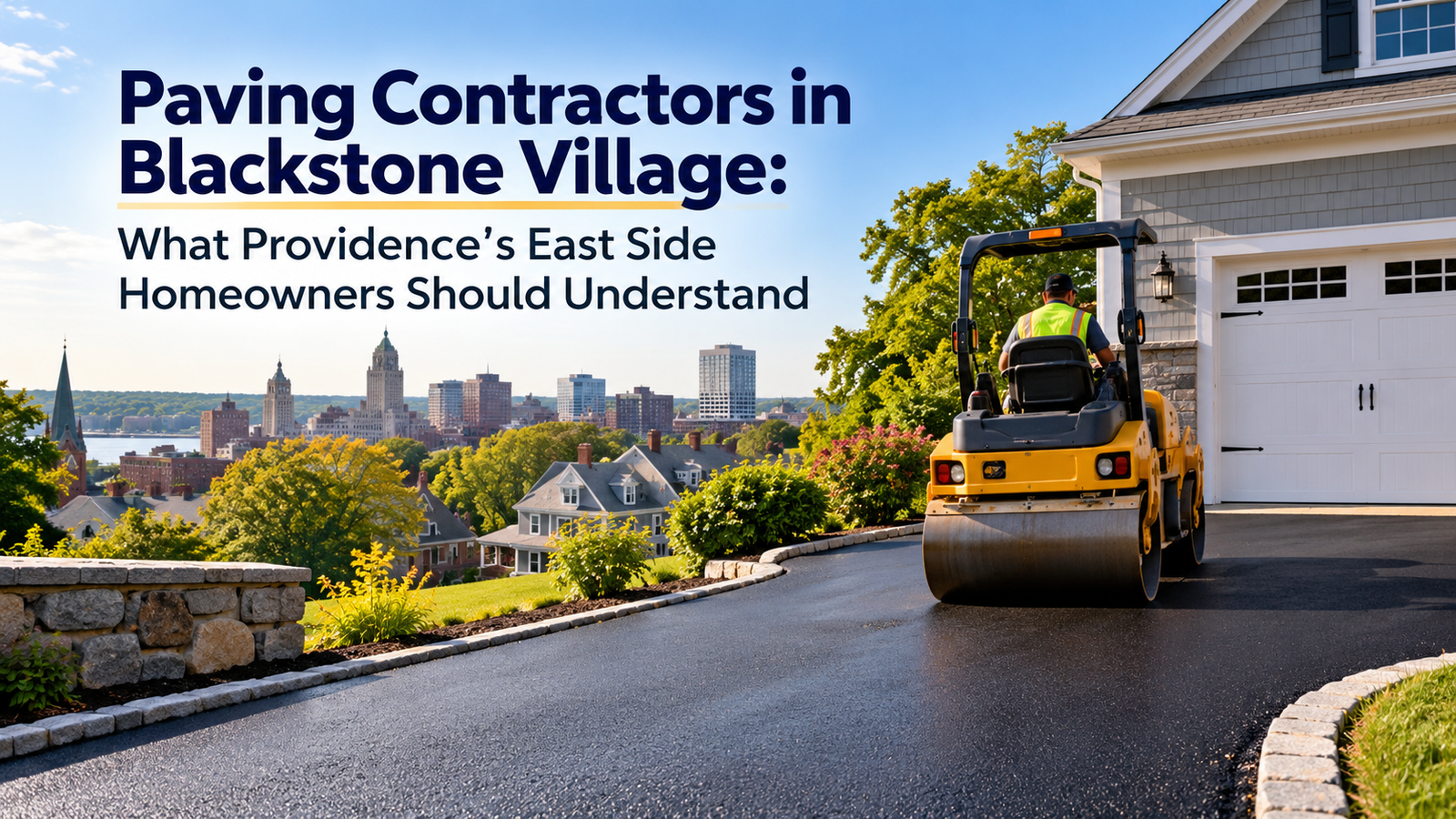
Blackstone Village is one of the most distinctive residential neighborhoods on Providence’s East Side a community defined by mature tree canopies, historic homes, and the linear green corridor of Blackstone Boulevard that anchors neighborhood identity. The area stretches along the eastern margin of Providence, bounded by the Seekonk River to the east and the Hope Street commercial strip to the west. The combination of old-growth trees, compact lot configurations, and structures built across a century of architectural history creates Paving Contractor Blackstone Village challenges genuinely distinct from suburban or newer urban markets.
The East Side Tree Canopy and What It Does to Asphalt
The single most distinguishing factor for paving work in Blackstone Village is the tree canopy. Decades-old oaks, maples, sweetgums, and other hardwoods have root systems extending well beyond their drip lines and reaching beneath driveways, sidewalk strips, and shared access lanes. Root-driven pavement heaving is the most common structural failure mode specific to East Side Providence driveways, presenting differently from the freeze-thaw cracking that dominates Rhode Island pavement damage elsewhere.
When a large lateral root grows in diameter beneath an asphalt driveway, it applies upward pressure over a span of several feet, creating a raised ridge or buckled zone distinguishable from thermal cracking. The crack pattern follows the root path often a linear ridge with associated cracking on either side rather than running transversely or randomly. Left unaddressed, the heave worsens each growing season as the root gains additional girth, and water entering through the cracks accelerates base deterioration around the root mass.
Addressing root-driven damage correctly requires more than cutting the problematic section and repaving. If the root is cut without additional intervention, the tree’s regenerative capacity will produce new growth in the same zone within two to five growing seasons and the heaving will recur. The appropriate approach involves consultation with an ISA-certified arborist to assess how much root removal is safe without compromising the tree’s structural integrity, installation of root barriers during the repair to redirect future growth downward and away from the paved surface, and coordination between the paving contractor and the arborist so each party understands the constraints the other is working within.
Providence’s urban forestry program protects street trees homeowners cannot unilaterally remove or severely prune a city-owned tree adjacent to their driveway. Homeowners can submit requests to Providence DPW’s arborist division for evaluation of trees causing property damage, document the damage with photographs, and engage a licensed arborist for guidance on private tree management. Paving contractors who regularly work on the East Side are familiar with this dynamic and can help property owners navigate it.
Freeze-Thaw Cycling in the Providence Urban Environment
Rhode Island winters are among the most damaging for asphalt pavement in the northeastern United States. The state typically experiences 30 to 50 or more freeze-thaw cycles per winter season temperature transitions through the 32-degree Fahrenheit threshold with each crossing representing a potential damage event for any pavement surface that has open cracks allowing water entry.
The mechanism is well understood: water enters a crack during a thaw period, freezes as temperatures drop, expands approximately nine percent as it converts to ice, and mechanically widens the crack before melting again. Over 30 to 50 repetitions of this cycle in a single winter, a minor surface crack that was easily sealed in October becomes a structural opening by March.
Blackstone Village driveways experience an additional moisture factor relative to more open suburban properties. The extensive tree canopy dramatically reduces how quickly paved surfaces dry after rain or snowmelt events. Shaded asphalt stays wet far longer than sun-exposed asphalt, extending the contact time between surface water and any cracks or porous areas in the surface film. This prolonged moisture exposure increases the volume of water that infiltrates before each freeze event, intensifying freeze-thaw damage per cycle.
Sealcoating is particularly important in Blackstone Village precisely because of this extended moisture exposure. A properly applied sealcoat fills the micro-surface voids through which water diffusely infiltrates between visible cracks. In an open suburban environment, sealcoating every three to five years may be adequate. In the shaded, high-moisture environment of Blackstone Village, the upper end of that frequency range every three years is the more protective choice.
Lot Configuration and Equipment Access on the East Side
Blackstone Village’s residential lots reflect early to mid-twentieth century development patterns driveways are frequently narrow (often 9 to 11 feet wide), run along the side of the house to a detached rear garage, are bounded by stone walls or established plantings on one or both sides, and sometimes involve shared access lanes serving adjacent properties.
These configurations create real equipment access challenges. Full-size paving equipment appropriate for commercial parking lots or wide suburban driveways cannot work effectively in a 10-foot-wide corridor bounded by a stone wall on one side and a landscaping border on the other. Quality paving contractors serving Blackstone Village maintain smaller equipment: mini-excavators for base preparation and tight-space grading, compact paving machines or hand-laid sections where machine access is impossible, and appropriate compaction equipment for constrained areas.
Stone walls are an additional consideration. Many East Side properties have historic stone walls directly adjacent to the driveway edge. Equipment operating near stone walls must maintain appropriate distance, and any soil disturbance adjacent to a wall foundation should be approached carefully to avoid destabilizing the wall’s base.
The Rhode Island Maintenance Cycle for Blackstone Village Driveways
Properly maintained asphalt in Rhode Island’s climate follows a predictable maintenance cycle. A new driveway should not be sealcoated for at least 90 days after installation, with one full year being the preferred minimum. New asphalt needs to complete its curing and off-gassing process before a sealcoat is applied.
After the initial cure period, the maintenance schedule looks like this: sealcoating every three to five years, timing the application for dry, warm weather (surface temperatures consistently above 50 degrees Fahrenheit with dry forecast for 24 to 48 hours after application), preceded by crack sealing of any cracks that have developed since the last maintenance cycle. Crack sealing should ideally happen in September or October before the first freeze event of winter, while the surface is still warm enough for hot-pour sealant to flow and bond properly into the crack void.
Hot-pour rubberized crack sealant is the correct specification for Rhode Island conditions. Applied at 375 to 400 degrees Fahrenheit from a melting kettle, hot-pour sealant penetrates the crack void, bonds to the crack walls, and cures to a flexible material that accommodates seasonal thermal movement without debonding. Cold-pour crack fillers from hardware stores are rigid, achieve poor adhesion, and typically fail within one to two Rhode Island winters.
This maintenance program consistent sealcoating every three to five years and fall crack sealing can extend the functional life of a properly installed Blackstone Village driveway to 20 to 25 years before reconstruction is warranted. Driveways that skip maintenance cycles deteriorate on a compressed timeline, with freeze-thaw cycling exploiting every unsealed crack through each winter and progressively weakening the base structure.
Providence Permits and Regulations for Blackstone Village Paving
Paving work in Blackstone Village that touches the public right-of-way including the sidewalk strip between the street curb and the property line, curb cut modifications, or any work within the Providence City right-of-way requires permits from the Providence Department of Public Works. The DPW’s Office of City Properties administers encroachment permits for private work within public rights-of-way. Standard replacement of an existing driveway on private property within its existing footprint typically does not require a building permit in Providence.
Projects that significantly expand impervious surface, create new curb cuts, or modify drainage in ways that affect adjacent properties or the public right-of-way may trigger additional requirements. Providence’s stormwater management ordinance, which implements state and federal stormwater requirements in the city, applies to development and redevelopment activities that increase impervious surface significantly.
Frequently Asked Questions About Paving Contractors in Blackstone Village
Can a Providence paving contractor remove roots causing driveway heave? A paving contractor can excavate and remove root material that has heaved the driveway surface as part of a driveway reconstruction project. What the paving contractor cannot assess is how much root removal is safe for the tree’s health that assessment requires an ISA-certified arborist. For Providence street trees, the city’s arborist division must be involved before significant roots are removed from a city-owned tree. The most durable solutions combine root removal (within what is safe) with root barriers that redirect future growth.
How do I know if my Blackstone Village driveway needs resurfacing or full replacement? Look for alligator cracking the interconnected polygon pattern that signals base failure. Walk the driveway and press on deteriorated areas with your foot: sound base feels rigid; failed base feels soft or springy. Widespread alligator cracking, soft areas, or significant depression indicates the base has failed and resurfacing will not provide lasting results. Surface cracking, oxidation, and edge raveling without alligator cracking and without soft areas may qualify for resurfacing over an intact base.
What is the best time of year for a Blackstone Village driveway project? Rhode Island’s paving season runs from approximately late April through October. For major driveway work, the May through September window provides the most consistently favorable conditions. Fall crack sealing in September or October is the highest-priority seasonal maintenance activity closing cracks before winter freeze events prevents the most damage.